A Bouquet, Apparently. Allegedly. If You Squint.
An acrylic on canvas by "Barbara" tries to be a Joan Mitchell, settles for being a placemat at a brunch spot that closed in 2019.
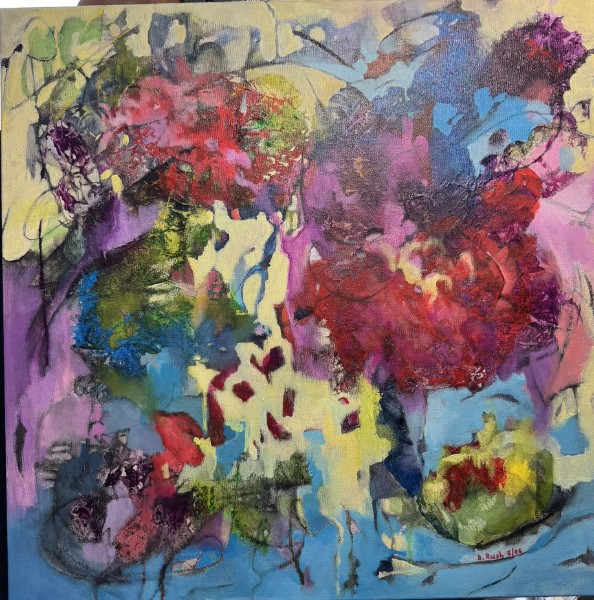
Barbara, untitled, acrylic on canvas, undated — and unsigned, which is the painting's first honest decision.
The pitch
There is a school of painting in which color is allowed to do the heavy lifting because the artist has nothing else in the truck. This painting is enrolled. It arrives in a great gust of pink, blue, and confidence, and then — having committed to the gust — does not appear to have a second act, a third act, or, frankly, an ending. It is a bouquet. We are told it is a bouquet. The painting itself is undecided, and would prefer not to be pressed on the matter.
The color defense will now be cross-examined
Yes, the palette is loud. Loud is not the same as good. Loud is what you do when you are not sure if you are interesting, and you would like the room to err on your behalf. The hot pinks scream at the cobalts, which is what hot pinks and cobalts do when forced into a room together by a hostess who has clearly given up on assigned seating. The much-praised "vibrating complementaries" here are vibrating mostly because they are nervous.
The pale yellow ground is the painting's one stroke of accidental brilliance, and it was almost certainly the underpainting Barbara forgot to cover. We will be generous and call it intentional.
Composition: a crime scene with better lighting
The eye is led, we are assured, in "a loose counter-clockwise spiral." The eye is led, in practice, the way a tourist is led through Times Square: against its will, at speed, and toward something it did not want to see. The lower-left quadrant is where forms go to die — a soggy parliament of darks that cannot agree on whether they are leaves, shadow, a vase, or a regrettable Tuesday. The middle of the canvas is a parking lot of mid-values where every petal is double-parked.
Looseness, in painting, is a privilege earned by knowing what tightness looks like. This canvas has not paid the entry fee and is loitering near the door hoping no one checks.
Brushwork, enthusiastically
The brushwork is described, charitably, as "gestural." A less charitable observer would describe it as indecisive. There are scumbles, drags, dabs, and the occasional contour line that begins with great confidence and then remembers it has somewhere else to be. Acrylic is a punishing medium for the hesitant; it dries before the artist can change her mind, which is unfortunate, because changing her mind is the painting's primary activity.
Value range: hello, is anyone in here?
Squint at this painting and it collapses like a soufflé in a slammed door. The saturation is doing the work of the values, the values are at the beach, and the highlights are pretending to be on the way. There is no true white, no true black, and no apparent ambition to recruit either. The result is a painting that is loud in color and mute in structure — a karaoke performance of a song nobody requested.
The mood
Frantic. Specifically: the frantic energy of a painting that suspects, deep down, that it might be finished, and is hoping nobody notices in time to ask.
What would it take to save this patient?
- Triage the lower left. Pick a single dark, confident shape and commit to it the way a grown adult commits to a haircut. Whether it is a vase, a leaf, or the void is less important than the fact that somebody made a decision in this house.
- Sacrifice the weakest half of the blossoms. Glaze them back into the ground with a thin warm wash. There is no painting in history improved by having more flowers. There are dozens improved by having fewer.
- Reintroduce value. A near-white, a near-black, exactly once each. Yes, you have to. No, your "warm beige" is not a substitute.
- Stop touching it. The greatest gift you can give this painting is the absence of your brush for seventy-two hours. If you cannot manage seventy-two, try thirty. If you cannot manage thirty, the painting is making a statement about you that we are too polite to publish.
- Sign it. Then put it somewhere you cannot reach it without a stepstool. Acrylic painters die from the same disease: one more pass.
The verdict
Two stars: one for nerve, one for the yellow ground that did most of the heavy lifting and won't be credited in the program. The painting is not bad. The painting is not good. The painting is in negotiations, and the negotiations are going badly for the painting.
Barbara has a real eye for color and the courage to use it without a permission slip. That is not nothing — that is, in fact, the rarest ingredient. Everything else on this canvas is fixable in an afternoon by someone willing to be ruthless. The question is not whether Barbara can finish this painting. The question is whether she can stop loving it long enough to be cruel to it. Painting, like parenting, occasionally requires both.